
You are drowning in traffic. (Or maybe just a steady trickle of polite likes.) Your posts go live. People read them. They even nod along.
Then? Nothing. Crickets.
No inbound inquiries. No new clients filling your calendar. No revenue growth.
Let's be brutally honest: you do not have a content problem. You have a conversion problem. Most entrepreneurs treat content like a digital diary or an endless encyclopedia of free advice. They optimize for eyeballs, applause, and algorithm metrics. They chase vanity numbers while their bank account stays flat.
Stop writing for the algorithm. Start writing for the sale.
Here is why your content isn't converting: and the exact blueprint to fix it today.
1. You Are Optimizing for Attention, Not Decisions
Look at your last ten pieces of content. What was their exact job? If your answer is "to provide value" or "to build brand awareness," you have found your leak.
Attention is currency, but it is not revenue.
Most content stops abruptly at “That was helpful!” It never bridges the crucial gap to “This is the exact solution I need to buy right now.” When you educate your audience so thoroughly that they solve their problem entirely on their own, you create a self-service plateau. They get what they came for, pat you on the back, and leave.
The Fix: Shift from teacher mode to strategist mode. Every piece of content must guide the reader one step closer to your paid offer. If you explain the what and the why, you must position your services or products as the definitive how.
Need help auditing your digital footprint? Explore our business consulting services to transform your content engine into a revenue-generating machine.
2. Your Strategy Misses the Bottom of the Funnel

Let me guess your content mix. Eighty percent top-of-funnel educational blog posts, industry trend rundowns, and quick social media tips. Ten percent promotional announcements. Zero bottom-of-funnel conversion assets.
If you lack high-intent bottom-of-funnel (BOFU) content: such as detailed case studies, pricing breakdowns, implementation frameworks, or direct comparisons: your prospects have nowhere to land when they are finally ready to buy.
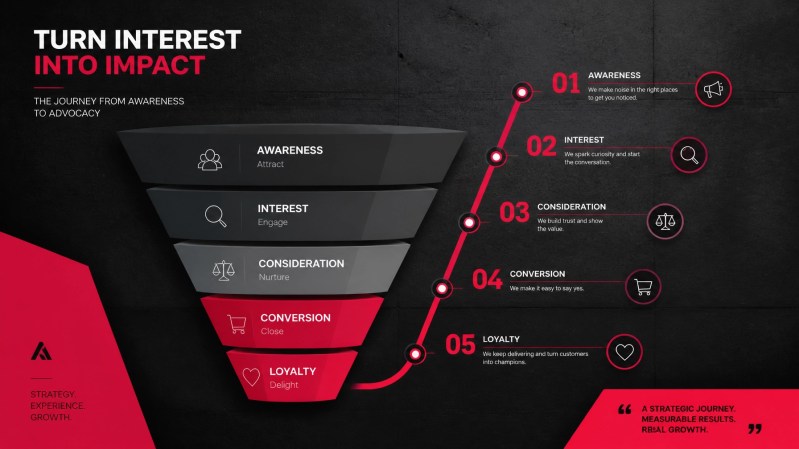
- Top-of-funnel content introduces the problem.
- Middle-of-funnel content builds authority and trust.
- Bottom-of-funnel content closes the deal.
Without BOFU assets, even motivated buyers hesitate. They cannot justify taking a leap of faith when your website only offers high-level theories.
The Fix: Build destination content for decision-makers. Publish real client transformations, transparent process breakdowns, and actionable guides that prove your methodology works. (Read our breakdown on how to create great blog content to master this balance.)
3. Your Calls-to-Action Are Weak (Or Missing Entirely)
Imagine walking into a high-end retail store. The staff greets you warmly, answers your questions, and hands you an incredible catalog. Then, as you reach for your wallet to purchase, they turn around and walk away.
That is what a passive “Contact us” or “Learn more” button does to your readers.
Generic CTAs create friction. They force the prospect to guess what happens next. Do they have to fill out a lengthy 10-field form? Will they be trapped in an aggressive sales pitch?
The Fix: Deploy specific, benefit-driven, contextual CTAs. Match the call-to-action directly to the pain point discussed in that specific article.
Instead of “Contact Us,” use:
“Get a 15-minute diagnostic teardown of your current marketing funnel.”
“Download the exact client onboarding checklist we use with coaching clients.”
Lower the barrier to entry. Make the next step irresistible, obvious, and immediate. For a masterclass in establishing authority that naturally drives clicks, review your ultimate introduction to personal branding.
4. You Are Ignoring Emotion and Friction
Business owners love logic. We talk about ROI, metrics, efficiency gains, and cost reductions. But humans make buying decisions based on emotion and fear: then justify them with logic later.
If your content reads like an academic textbook, it will fail to convert. If you ignore the underlying anxieties your prospect feels: fear of wasting capital, imposter syndrome, operational overwhelm: you leave them feeling isolated.
Furthermore, you are ignoring objections. Every reader has silent doubts: “Will this work for my specific industry?” “Is it too expensive?” “Do I have the time to execute this?” If you refuse to answer those objections head-on, your prospect’s internal hesitation wins.
The Fix: Weave empathy into your copy early. Acknowledge the late-night stress and pressure your ideal client faces. Then, dismantle their objections within an FAQ or dedicated objection-handling section before they even have a chance to click away.
5. You Treat Content as Isolated Posts, Not a Connected System
Stop treating your blog and social channels as a random series of disconnected episodes.
When a reader lands on your site via search or social, where do they go next? If your pages are dead ends, your bounce rate skyrockets and your conversion pipeline leaks like a sieve.
Content without architecture is just noise.
The Fix: Interlink your ecosystem. Create clear pathways that guide a cold visitor from a broad awareness article into a targeted consideration post, and finally onto a high-converting landing page. Check out these 5 social media marketing tips to grow your business to see how distribution feeds directly into your conversion engine.
Additionally, ensure your underlying user experience supports action. A slow-loading page or confusing mobile layout will kill conversions faster than weak copywriting ever could. For foundational site principles, review our guide on the 4 basics of good web design.
How to Fix It Today: Your 3-Step Action Plan

Enough analyzing. Let’s execute.
- Audit Your Top 5 Traffic Pages: Identify the articles or social posts that get the most views right now. Look at their current CTAs. Are they passive? Rewrite them immediately into high-benefit, specific next steps.
- Map the Missing Middle: Check your content calendar for conversion-stage assets. If you only have educational guides, write one comprehensive case study or service breakdown this week.
- Measure Pipeline, Not Impressions: Stop tracking vanity metrics like likes and shares. Track qualified leads, consultation bookings, and revenue generated directly from your content assets.
Content is not a branding charity. It is a commercial engine.
Dismantle the noise. Tighten your offer. Guide your audience across the finish line.
Your next client is already reading your content. Give them a reason to click buy.